
Validation of Questionnaire for Assessing Patient Safety Culture: Knowledge, Awareness, Attitudes and Practice among Medical Doctors
Validation of KAAP Questionaire
Vol. 21 No. 1 : 2026 (475-502)

Abstract
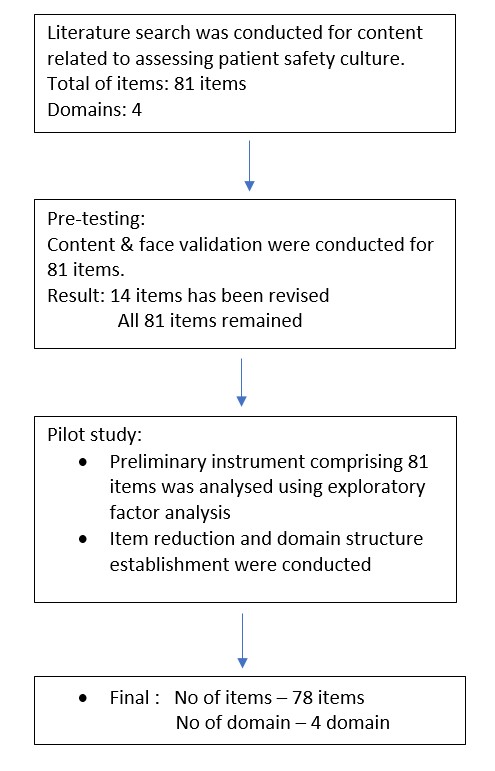
Patient safety culture is an essential element of healthcare quality, influencing clinical outcomes and patient well-being. Assessing healthcare professionals’ practice, awareness, knowledge and attitudes toward patient safety are crucial for cultivating a culture of safety. This study focuses on validating a newly developed instrument designed to evaluate patient safety culture across these dimensions, providing a standardised tool for evaluating and improving safety practices in healthcare settings. A systematic literature review informed the development of the instrument’s domains and items. Content validity was performed by subject matter experts, yielding good content validity index (CVI) values: relevance (0.988), simplicity (1.000), clarity (0.914) and ambiguity (0.901). Face validity index (FVI) was 0.802, based on feedback from medical officers. Modified kappa values ranged from 0.52 to 1.00, indicating fair to excellent agreement beyond chance. The finalised questionnaire was administered to 124 medical officers. The sphericity test by Bartlett was highly significant (p < 0.001), confirming the data’s appropriateness for factor analysis, and sampling adequacy measures exceeded the 0.6 threshold. Exploratory factor analysis (EFA) showed that retained items had factor loadings above 0.6, affirming construct validity. The instrument demonstrated excellent internal consistency, with Cronbach’s alpha exceeding 0.8 across constructs. Overall, the EFA and reliability assessment confirmed the robustness of the developed questionnaire. This result provides a good indication of reliability and the effectiveness of the instrument for assessing patient safety culture includes practices, awareness, knowledge and attitudes among healthcare professionals. This validated tool offers significant utility for assessing and improving patient safety culture among healthcare professionals, ultimately contributing to better patient care and safety outcomes in healthcare environments.
Keywords :
Factor analysis; patient safety attitude; patient safety awareness; patient safety culture; patient safety knowledge,
Correspondance Address
Aniza Ismail. Department of Public Health Medicine, Faculty of Medicine, Universiti Kebangsaan Malaysia, Jalan Yaacob Latif, Bandar Tun Razak, 56000 Cheras, Kuala Lumpur, Malaysia.
Tel: +6019 3217343 Email: aniza@hctm.ukm.edu.my


